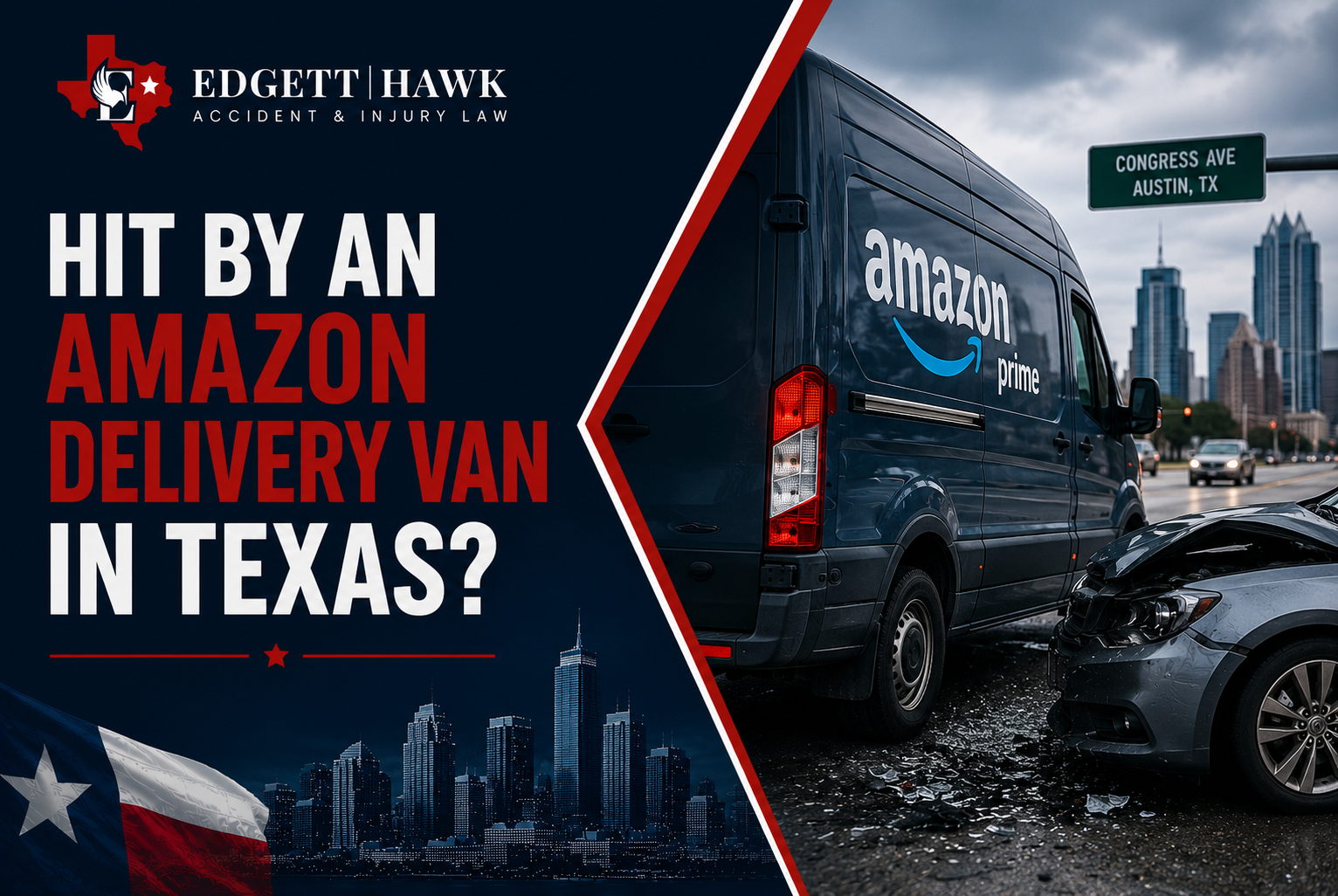
The van that hit you had the Amazon smile on the side. The driver wore an Amazon vest and scanned your street address into an Amazon app. So when the phone calls start, almost everyone assumes Amazon is the company that will answer for what happened. In Texas, that assumption is usually wrong, and the distance between what the van looked like and who actually owes you money is where these cases are won or lost.

The Logo on the Van Is Branding, Not an Employment Record
Amazon does not move most of its packages with its own employees. It built a delivery network out of layers, and each layer is a separate legal entity with its own insurance, its own lawyers, and its own incentive to point at somebody else. The vans are branded so consistently that the public reads them as Amazon vehicles driven by Amazon staff. Legally, they usually are not.That structure is not an accident. Keeping drivers at arm's length is what limits the parent company's exposure when one of those vans runs a light in Plano or rear-ends someone on the Dallas North Tollway.
Four Different People Could Have Been Driving That Van
Before anyone can tell you who pays, someone has to establish which part of the network the driver belonged to:
- Delivery Service Partner drivers, who wear the uniform and drive the branded van but are employed by a separate local delivery company
- Amazon Flex drivers, gig workers who deliver in their own personal vehicles during scheduled blocks
- Third-party freight and line-haul carriers, who move trailers between warehouses and fulfillment centers
- Direct Amazon employees, which is by far the smallest group you will encounter on a residential street
Each of those points to a different policy and often a different defendant. Getting this wrong at the start costs months, and sometimes costs the claim.
Who Can Actually Be Held Liable Under Texas Law
Texas follows respondeat superior, which makes an employer responsible for the negligence of an employee acting within the course and scope of the job. When a Delivery Service Partner's driver causes a wreck on route, that contractor is on the hook for its driver. Amazon's arrangement is built to stop the chain right there.
- The driver, for the underlying negligence
- The Delivery Service Partner or carrier that employed the driver
- Amazon itself, where the facts show it exercised real control over how the work was done
- A maintenance contractor, if brake or tire failure contributed
- A vehicle or parts manufacturer, in a defect case
When Amazon Itself Can Be Pulled Into a Texas Case
Labeling someone an independent contractor does not settle the question. Texas courts look at the right of control that was actually exercised, not the word used in the contract. In this network, control shows up in places that are easy to document once you know to ask for them.
- Routes, stop sequences, and delivery windows dictated through the company's own app
- Scanner metrics, on-time rates, and driver scoring that effectively set the pace of the workday
- Requirements about uniforms, vehicle branding, and how the job is performed
- Negligent selection, hiring, or retention where a contractor with a known safety record kept operating
None of this is automatic, and no honest lawyer will promise you the parent company at the outset. It is a fight worth having when the contractor's policy will not cover what happened to you.
The Insurance Layers That Decide What You Can Recover
Delivery Service Partners are required to carry commercial auto liability coverage, and that policy is normally the first place a claim lands. Flex drivers are covered by a commercial policy that generally provides up to $1 million in liability while the driver is on an active delivery block.The word active is doing heavy lifting in that sentence. A Flex driver who has finished a block, or who was heading to a pickup rather than delivering, may fall into a gap where the commercial policy has switched off and their personal insurer denies the claim as commercial use. The timestamps in the app decide which side of that line your case falls on, which is why those records matter more than almost anything else.
The Evidence That Disappears While You Are Still in the Hospital
Delivery vehicles generate a remarkable amount of data, and very little of it is kept for long. Almost all of it sits with companies that have no reason to hand it over voluntarily.
- Telematics and GPS data showing speed, braking, and position
- Route assignments and package scan timestamps
- In-vehicle camera footage, which is frequently overwritten within weeks
- The driver's app records establishing whether a block was active
- Vehicle maintenance and inspection history
- The driver's qualification and training file
A written preservation demand sent to every entity in the chain, early, is what keeps this material from quietly aging out. Once it is gone, you are left arguing about what a witness thinks they saw.
Two Years, and the Clock Started the Day It Happened
Section 16.003 of the Texas Civil Practice and Remedies Code gives you two years from the date of the crash to file suit. Miss it and the strength of your case stops mattering.Two years feels generous until you watch it get spent. Identifying the right delivery company, running down which policies apply and in what order, sorting out whether a Flex block was active, and forcing preservation of app and telematics data all happen before anyone talks seriously about settlement. Cases that start at month twenty are cases that settle cheap.
What to Do If a Delivery Van Hit You in North Texas
The practical steps are not complicated, and they are worth more than most people realize:
- Photograph the van, the license plate, the DOT number, and any company name in smaller print near the door
- Get the driver's name and ask directly who employs them
- Report the crash and make sure a police report exists
- Get evaluated even if you feel functional, because delayed symptoms are common and gaps in treatment get used against you
- Say nothing recorded to any insurer until you know who they represent
That small print near the door is often the single most useful photograph you can take. It is frequently the only place the actual employer's name appears.
Does Amazon Pay for Accidents Caused by Its Delivery Drivers in Texas?
Often it is not Amazon that pays. Most Amazon-branded vans are driven by employees of Delivery Service Partners, which are separate companies that carry their own commercial auto insurance. That contractor's policy is usually the first source of recovery. Amazon can still be brought in directly when the facts support it, but that takes proof rather than the logo on the van.
What If the Driver Who Hit Me Was Using Their Own Personal Car?
That is likely an Amazon Flex driver. Amazon provides a commercial auto policy for Flex drivers that generally includes up to $1 million in liability coverage while the driver is on an active delivery block. The driver's personal auto policy usually excludes commercial delivery, so establishing whether they were on an active block at the moment of the crash matters enormously.
How Long Do I Have to File an Amazon Delivery Accident Claim in Texas?
Texas gives you two years from the date of the crash under Section 16.003 of the Civil Practice and Remedies Code. That sounds like plenty of time, but identifying the correct delivery company, the correct policy, and preserving app and telematics data takes months, so the practical deadline to start is far earlier.
Should I Accept the First Offer From the Delivery Company's Insurer?
Be careful. An early offer often arrives before anyone has confirmed which entities are actually on the hook or whether a second policy applies above the first. Accepting it typically releases every party connected to the claim, including ones you have not identified yet.
Talk to Someone Before the First Offer Arrives
Delivery cases look like ordinary car wrecks and behave like commercial trucking cases. Multiple companies, layered policies, evidence held by parties with no interest in sharing it, and an early offer designed to close the file before anyone has counted the coverage.If you or someone in your family was hit by a delivery vehicle anywhere in North Texas, Edgett Hawk Injury Law Firm in McKinney can find out who was really behind the wheel and which policies apply. Scott Edgett and Michael Hawk have spent decades taking on commercial carriers and their insurers. Call us for a free consultation. There is no obligation, and you pay nothing unless we recover for you.